Human Actors Are Still the Gold Standard. Never-Skilling Is Exactly Why AI Simulation Must Be Designed Carefully.
The NHS is scaling clinical training faster than simulation infrastructure can absorb. The answer is not AI replacing human actors. It is AI giving students safe repetitions before the human encounter.
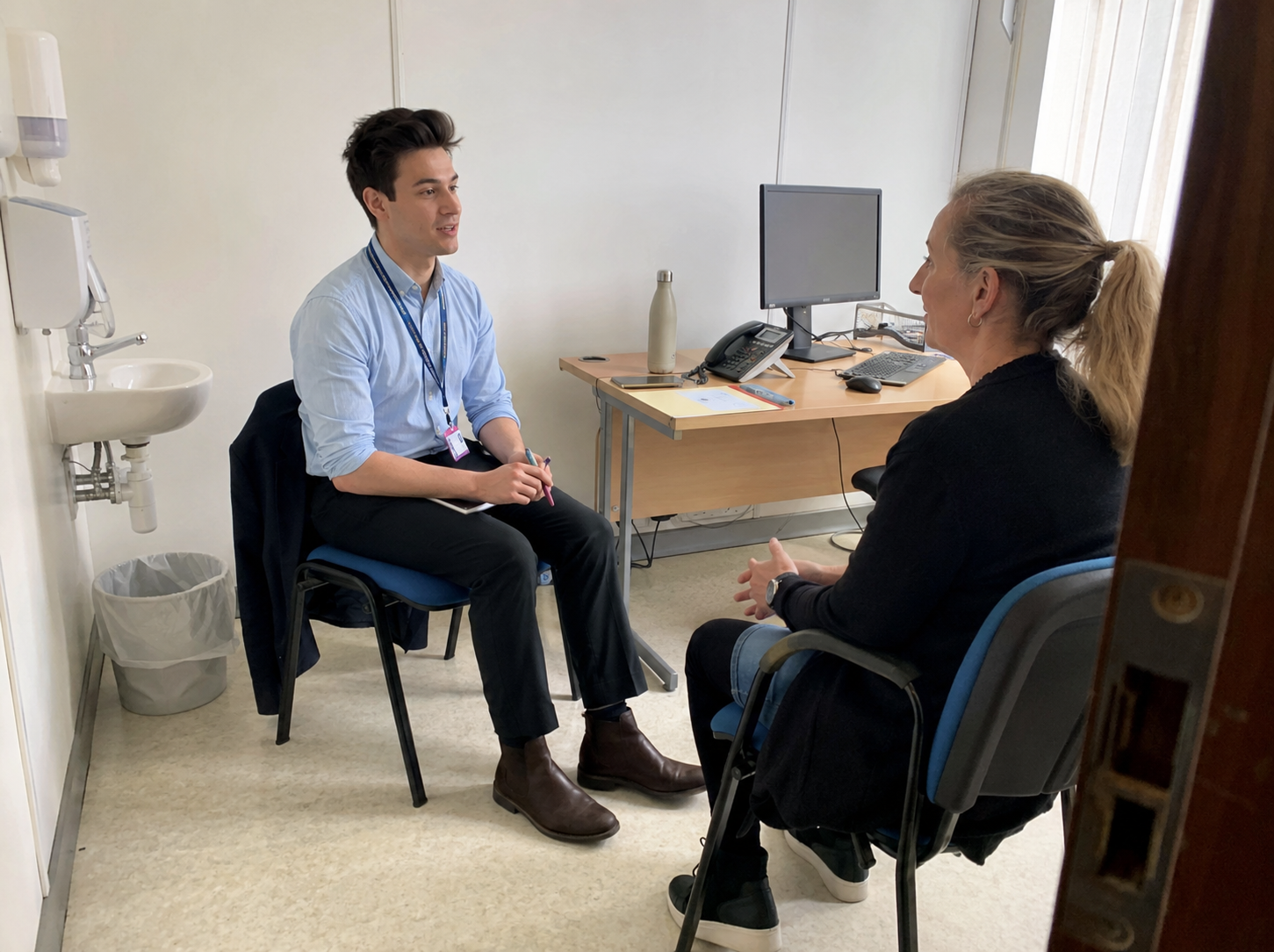
The question is not whether AI simulation can replace a skilled human actor. It cannot. The question is what happens to the students who never get enough time with one.
A recent Nature Medicine Perspective has raised an important warning about “AI-induced never-skilling”: the risk that trainees who rely on AI too early, or too passively, may fail to develop the foundational reasoning skills needed for safe independent practice.[4] That warning should be taken seriously. But it should not lead us to reject AI in education. It should force us to ask a better question: what kind of AI use protects clinical reasoning, and what kind bypasses it?
Key takeaways
- Human standardised patients remain the gold standard. AI simulation does not change that.
- The risk of “AI-induced never-skilling” is real when AI gives trainees answers before they have developed independent reasoning.
- Responsible AI simulation should not bypass clinical reasoning. It should create more opportunities to practise it.
- The NHS Long Term Workforce Plan commits to doubling medical school places to 15,000 by 2031/32. Current simulation models were not designed for that volume.
- AI simulation is most valuable as preparation for SP encounters, giving students repeated, feedback-rich practice before the moment that counts.
The infrastructure problem nobody is talking about loudly enough
The NHS Long Term Workforce Plan commits to doubling medical school training places from 7,500 to 15,000 by 2031/32.[1] Adult nurse training places are set to nearly double. GP specialty training places will increase by 50 percent.[2]
More students. Same rooms. Same faculty hours. Same SP budgets.
A student today might get two or three standardised patient encounters before an OSCE. Sometimes fewer. That is already not enough to build confident, safe communication skills. Researchers analysing the workforce plan have identified placement capacity as one of its most significant implementation risks.[3]
Doubling student numbers does not automatically mean doubling simulation time.
What responsible AI simulation can and cannot do
The risk is highest when AI gives students answers before they have done the cognitive work themselves. In clinical education, that could mean generating differentials, management plans or documentation in a way that removes the productive struggle of reasoning. That is not the role AI simulation should play.
Let's be direct about both.
What it cannot do
- Replace the genuine unpredictability of a skilled human actor
- Replicate the full non-verbal complexity of a real SP encounter
- Substitute for the tacit clinical judgement that develops through real human interaction over time
What it can do
- Give a student ten attempts at breaking bad news before the one that matters
- Require students to gather information and commit to their own reasoning before receiving feedback
- Provide structured feedback on consultation flow, clinical omissions, safety issues and communication behaviours
- Create repeated opportunities to practise differentials, red flags, documentation and escalation decisions without giving students a pre-written answer
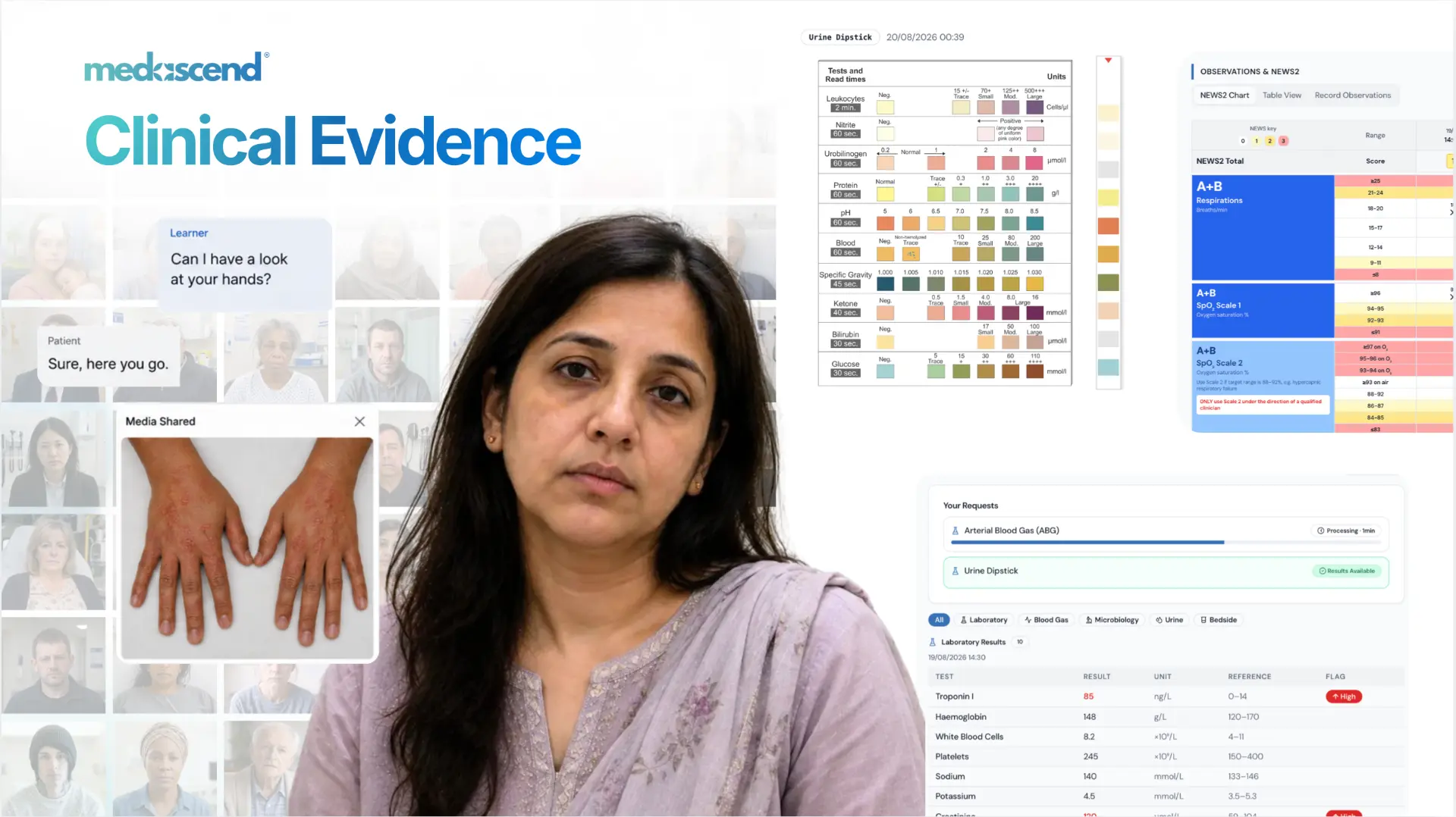
- Deliver video simulation for distressed relatives, mental health risk assessment and de-escalation scenarios that are expensive and logistically difficult to run at scale
The goal was never substitution. It was preparation.
ModalityMatching the simulation to the learning objective
Voice simulation
Suited for:
- History-taking structure and consultation flow
- Question phrasing and verbal reasoning
- Repeated practice at scale
- Early confidence building
- Remote or asynchronous practice
Video simulation
Adds most value when the objective involves:
- Breaking bad news
- Distressed relatives
- Mental health risk assessment and capacity assessment
- De-escalation
- Telemedicine realism
- Recognising hesitation or emotional distress
The responsible question is not whether voice or video is better than a human actor. It is what a student needs before they sit across from one.
So that when it counts, it is not their second attempt. It is their fifteenth.
Preparation, not substitution
Human standardised patients are irreplaceable for the same reason they have always been: a skilled SP brings improvisation, embodied presence and genuine human response that no platform replicates.
What AI simulation changes is what a student brings to that encounter.
More attempts. More feedback. More chances to fail safely, adjust and try again, before the session that has real consequences.
That is not a threat to the SP model. It is an argument for investing in it more seriously, with AI absorbing the volume that the current model was never able to provide.
Designing against never-skilling
Never-skilling is not caused by AI alone. It is caused by the wrong educational design.[4]
An AI tool that gives a trainee the answer can weaken learning. An AI simulation that requires the trainee to take a history, make decisions, explain reasoning, document their thinking and receive structured feedback can do the opposite.
Used well, AI simulation should increase the number of times a student has to think clinically, not reduce it.
It should create more repetitions of the reasoning process: asking focused questions, recognising red flags, forming differentials, communicating uncertainty, documenting safely and reflecting on feedback. The aim is not to automate judgement. The aim is to practise the behaviours that build it.
Why MedAscend built it this way
- 1
Co-designed with educators
Across medicine, nursing, pharmacy, physician associate and allied health programmes, not delivered to them as a finished product.
- 2
Modality chosen by learning objective
Voice and video serve different purposes and we don't pretend otherwise.
- 3
Assessment tied to institution-defined rubrics
Feedback traceable to evidence in the consultation, not generated in a black box.
- 4
Honest about what is still developing
Bias evaluation, long-term outcomes and post-launch monitoring remain areas of active work across the whole sector.
- 5
Designed not to bypass reasoning
Students are expected to ask, decide, document and reflect. AI feedback comes after performance, not as a substitute for the performance itself.
The standardWhat earns institutional trust
The platforms that will earn institutional trust are not the ones claiming to replicate human actors.
They are the ones that are clear about what they do, built with the educators responsible for outcomes, and designed to send students into human encounters better prepared than they would otherwise be.
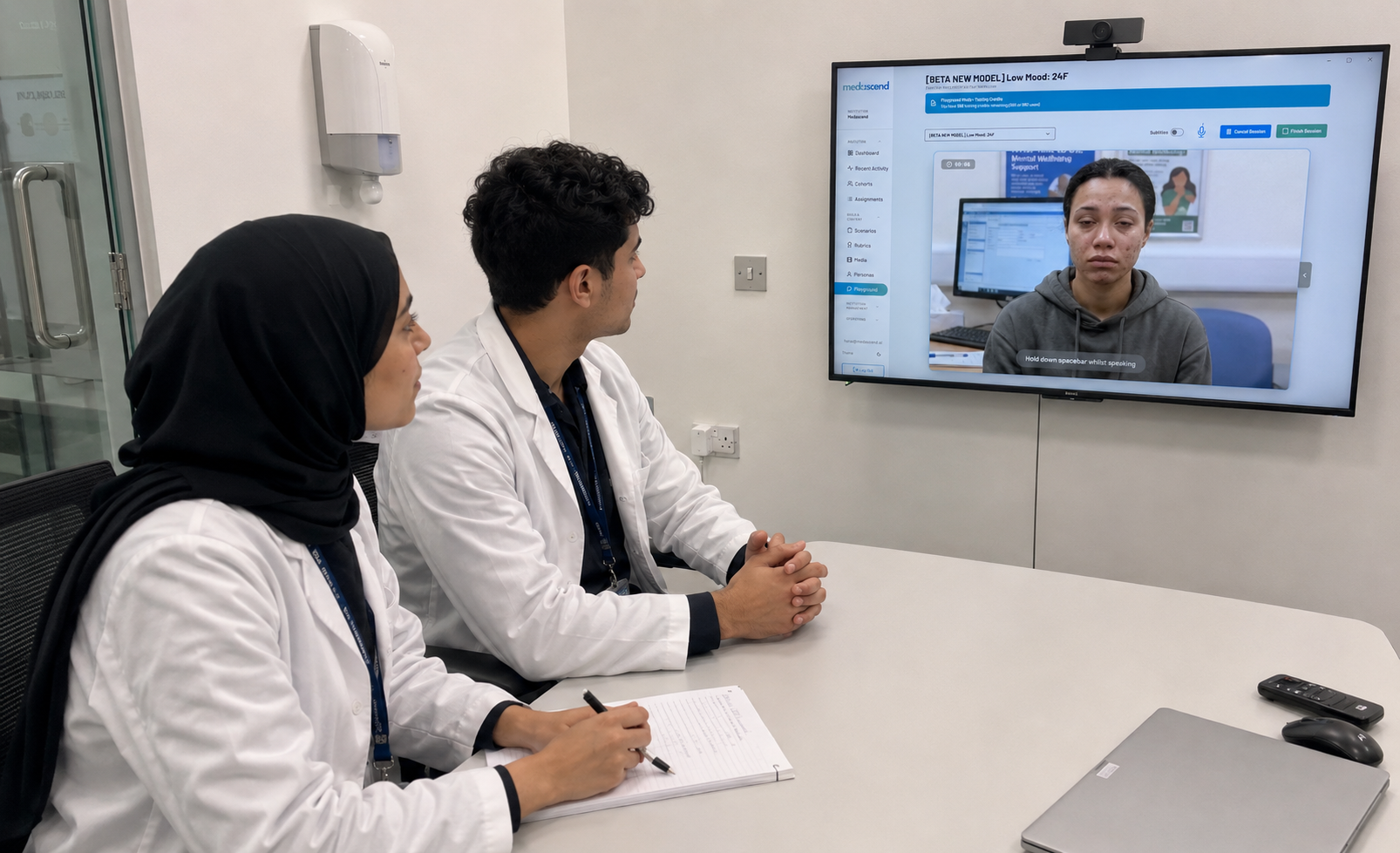
Book a demo to see how MedAscend supports relational skills training across voice and video simulation, built to sit alongside your existing SP programme.
References
Sources cited in this article
- 1.NHS England. NHS Long Term Workforce Plan. June 2023. https://www.england.nhs.uk/long-read/nhs-long-term-workforce-plan-2/
- 2.NHS England. About the Plan. https://www.england.nhs.uk/ltwp/about-the-plan/
- 3.Svirko E et al. Mind the implementation gap. British Medical Bulletin. 2024;150(1):1–16. https://academic.oup.com/bmb/article/150/1/1/7604888
- 4.Perspective on AI-induced never-skilling in medical education. Nature Medicine. 2026. https://www.nature.com/articles/s41591-026-04438-y